Flambée des prix producteurs et des ventes de détail américains ; le dollar s’envole

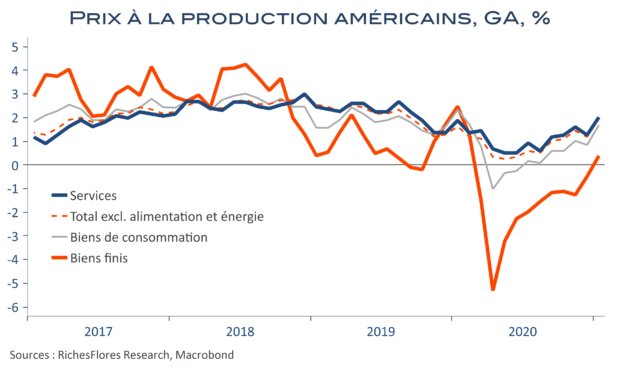
L’année a démarré en trombe aux Etats-Unis avec une envolée de plus de 5 % des ventes de détail nominales et un rebond de 2 % des prix producteurs en janvier. Pas de distorsion particulière pour expliquer ces résultats : les ventes ont fortement progressé dans la plupart des secteurs, comme c’est le cas pour les prix avec, en particulier, une remontée de 1,3 % dans les services, la plus forte hausse mensuelle depuis l’origine de la série en 2009. Si ces données ont peu d’effets sur les taux d’intérêt, c’est sans doute que ces derniers ont pris une certaine avance ces derniers jours. Le dollar réagit davantage avec une progression de 0,5 % de l’indice ICE et un net repli de l’euro, à 1,204USD.
You need to be logged in to view the rest of the content. Veuillez . Not a Member? Nous Rejoindre

Chute des ventes de détail allemandes avant même la hausse de la TVA

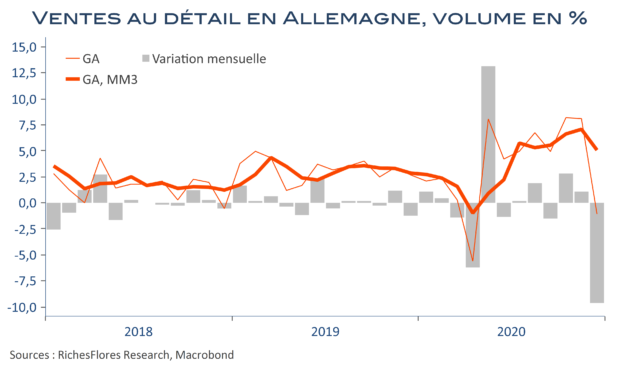
En décembre les ventes de détail allemandes ont chuté de près de 10 %. Il s’agit de la plus forte baisse mensuelle depuis plus de 60 ans. Les ventes de détail avaient rapidement récupéré de la crise du premier semestre grâce aux mesures de soutien gouvernemental, en particulier la baisse de la TVA de 19 % à 16 %. Fin novembre, elles affichaient une progression de 8 % sur un an, une exception par rapport aux autres indicateurs. Bien que la dégradation des conditions sanitaires laissât supposer un mois de décembre un peu moins bon, l’effet « TVA réduite » devait encore soutenir les achats de biens des ménages. C’est, au vu de ces chiffres, les effets de l’épidémie qui l’ont largement emporté, et les ventes de détail allemandes terminent l’année en recul de 1 % par rapport à décembre 2019.


You need to be logged in to view the rest of the content. Veuillez . Not a Member? Nous Rejoindre

Le climat des affaires allemand tangue, le commerce sombre

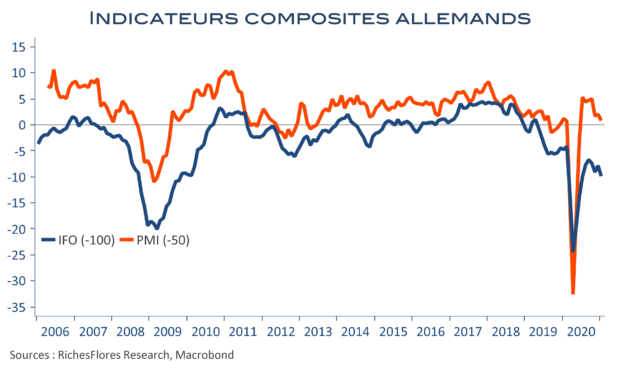
La plupart des indicateurs de climat des affaires de l’IFO pour l’Allemagne affichent des baisses plutôt faibles en janvier, à l’exemple de l’indice composite, qui s’établit à 90 après un recul de deux points de ses deux composantes, « perspectives » et « situation courante ». Son niveau, en revanche, reste toujours très faible, contredisant un PMI composite à 50,8, soit en territoire de croissance. L’occasion ici de rappeler la difficulté d’analyser, en termes d’activité économique, les indicateurs de climat des affaires de façon absolue. L’IFO est resté sous les 100 depuis la mi-2019, quand bien même la croissance au T3 2020 a été exceptionnelle, tandis que les PMI n’ont cessé d’afficher une valeur supérieure à 50 depuis la fin du premier confinement, malgré une dégradation de la situation sanitaire depuis la fin de l’année. Reste que les deux indicateurs s’accordent sur certains points du diagnostic : si le reconfinement a eu un impact franchement négatif sur l’activité, son ampleur en janvier demeure limitée par rapport aux restrictions précédentes, pour ce qui est de l’activité globale, du moins.


You need to be logged in to view the rest of the content. Veuillez . Not a Member? Nous Rejoindre

ECB: forced to miss its turn again households_confidence

Following the last monetary policy meeting on 25 January, there had been an increasing number of statements suggesting growing discomfort with the status quo advocated by Mario Draghi and his chief economist Peter Praet. Looking at the various comments, and particularly the optimistic tone of Benoît Cœuré, it seemed that the ECB would soon adjust its policy to provide less support to the economy. Since its asset purchase programme was scheduled to last until late September, many expected that, this spring, the ECB would state its intention to end the programme, and some even thought that it would mention a possible timetable for raising official interest rates in 2019. It therefore seemed that rates would rise, the yield curve would steepen, banks would enjoy better conditions and the euro would continue rising. However, the resulting euphoria did not last long. With a few days to go until the 8 March monetary policy meeting, the prospect of the ECB changing direction seems increasingly remote.

Lire la suite…

The rising euro is taking more wind than expected out of eurozone inflation’s sails

Until now, economists have not been particularly worried by the euro’s rise since the beginning of the year, given that business trends and confidence in future growth had gained momentum. At less than $1.20 since mid-summer, the euro is trading well below certain past levels and also more in line with its purchasing power parity. Recent data indicate, however, that the single currency’s appreciation has had a significant impact on corporate margins and on import prices, resulting in a reduction of core inflation rates in the eurozone. This is relatively disconcerting at this stage in the business cycle and may be behind the sluggish stock markets of the past few months.

Lire la suite…

The euro’s exchange rate is the ECB’s main concern, and so forging ahead on its chosen path is understandable

When, in September, Mario Draghi mentioned the euro exchange rate as one of the factors likely to influence the ECB’s monetary policy – alongside inflation and growth – few economists took him seriously. The euro’s rally since the spring, along with the obvious risk of a further rise if the ECB tightens monetary policy, meant that some caution was needed and made it acceptable to bend the previously established rule that the ECB bore no responsibility for the euro’s exchange rate. Seven weeks later, there no longer seemed to be any concern about this issue. Not only did eurozone economies, posting very good economic figures, appear to have coped with the euro’s rally, but the Fed had also clarified its strategy, reducing the risk of a further rise in the euro. As a result, the ECB was in theory able to relieve itself of the exchange-rate burden and make a more decisive commitment to bring its policy gradually back to normal.

Lire la suite…

China – The mortgaged future of the world’s biggest economy and the authoritarian temptation


During the five years of President Xi Jinping’s first term, Chinese economic growth was 7.1% p.a. on average, the lowest of the last 25 years, but the strongest of all emerging markets and even stronger when compared with developed countries. After climbing to first place in the global ranking in 2013, the Chinese economy has only widened the gap with the United States. Its GDP in purchasing power parity terms was 20% greater than that of the US in 2016. China has no lack of first-place distinctions. With more than 18% of the world’s GDP and a population of 1.4 billion, the highest in the world, China has taken first place in many areas as its economy has grown. And it is probably not ready to stop, even if its growth is showing structural decline.

Lire la suite…

Janet Yellen: a hawk among doves

Far from confirming the determination to tighten monetary policy shown by Janet Yellen after the Fed’s monetary policy meeting in September, the minutes from the FOMC’s latest meeting show that its members remain highly undecided with respect to ongoing low inflation and the need to raise interest rates further before having confirmation that low inflation is a temporary phenomenon. Fed Chair Janet Yellen is now a hawk within the FOMC, whereas she had previously been a dove: as well as being intriguing, this U-turn creates doubt about the future direction of US monetary policy.

Lire la suite…