
How Effective is the Wealth Effect?

Download the article

The wealth effect—the increased consumer spending thought to result from rising financial and real estate asset prices—is frequently cited as a key argument for renewed faith in the U.S. economy today. That faith, however, may soon prove to be misguided, as we will attempt to show in this paper.

Economists use the term wealth effect in a very precise way: to explain how household savings patterns shift in response to changes in household net worth. When net worth goes up, due to an increase in the assessed value of homes or to rising stock prices, for example, people tend to set a smaller share of their wealth aside—in other words, their personal savings rate goes down, leaving more money for consumer spending. The term wealth effect basically refers to this higher consumption.

The wealth effect was particularly significant during the 2000s. It isn’t hard to demonstrate, for example, that in every year from 1998 to 2007, rising property values alone shaved as much as one percent off of the U.S. household savings rate. This made it possible for consumer spending to grow faster than disposable income, which had slowed as a result of weak job creation. For one thing, the perception of greater wealth created by rising asset prices tends to reassure households and boost consumer confidence in ways that encourage spending. For another, in countries with highly developed mortgage markets, increased net worth improves household balance sheets and enables homeowners to borrow more extensively. The macroeconomic benefits often produced by these factors would, of course, be particularly welcome in the United States today, since the Federal Reserve’s policies have turned out to be more effective in driving up assets prices than in stimulating the broader economy.

However, a number of problems are likely to prevent the wealth effect from operating as in the past:

  • The first, and by far the biggest one, is the current savings rate in the U.S. Because the processes described above don’t directly generate income, they can’t influence growth unless consumers dip into their savings. This means that the strength of the wealth effect depends to a large extent on how high the personal savings rate initially is. As it turns out, that rate was equal to just 2.5 percent of U.S. disposable income in April, leaving very little room, if any, for a further decrease.
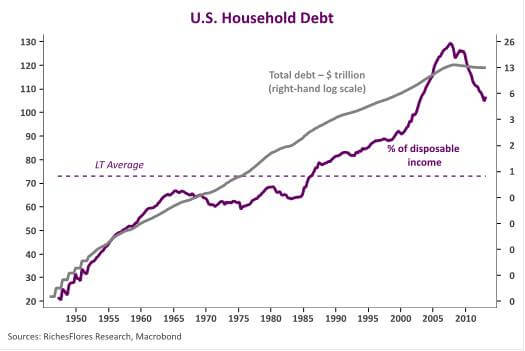
  • The second problem hinges on how much debt American households already carry and on whether paper wealth gains will enable them to borrow more. The answer is: they won’t unless those households can afford a higher debt ratio—a rather improbable scenario at this stage. To understand why, it is important to bear in mind the distinction between the household debt service and household debt ratios. Due to falling interest rates—which have allowed U.S. homeowners to refinance their mortgages—and to extensive debt cancellation brought about by the wave of foreclosures in recent years, debt service payments as a proportion of disposable income have plummeted. This decrease in the debt service ratio has made more money available to households and has therefore been a major contributor to the recovery in consumer spending over the past two years. But this process can’t rightfully be considered a wealth effect, and since it is already behind us, it is unlikely to be much of a stimulus to future consumption. The debt ratio, which measures the stock of household debt as a proportion of income, is the only reliable predictor of household borrowing capacity. Unfortunately, it has remained stubbornly high: barely 20 percent below its pre-crisis peak, and thus well above its long-term average. So there is probably very little scope for a substantial increase in U.S. household debt—which in any case would be a bizarre development right after a debt crisis of the kind we have just been through.

All this, along with low job creation numbers, should make it clear why we have more doubts than most on the prospects for buoyant consumer spending in the U.S.
Une_anglais

The U.S. Economy: Don’t Count Your Chickens Before They Hatch

Download the article

Sentiment on the U.S. economic outlook has gone from a flurry of uncertainty at the start of the year to renewed optimism. Admittedly, there are grounds for being bullish. Growth has held up despite tougher fiscal and tax policies; the housing market recovery has continued; and the Fed has stuck to its easy money policy. But let’s not get carried away! The latest numbers are no more encouraging than those available at the end of last year. In particular, decelerating productivity growth, with all that it implies in terms of profit, investment, and job trends in the next few quarters, may well drag the U.S. economy back down in the second half of the year. And with a policy mix that is less accommodative than before, the key ingredients for a genuine recovery are still nowhere to be seen. All this has conditioned our analysis on several points:

  • We wonder whether a change in monetary policy is on the short-term agenda—and worry that the Fed may withdraw its support too soon.
  • While we aren’t overly concerned about trends in the U.S. bond market and the euro’s exchange rate, we do suspect that the stock market will be more vulnerable to disappointing macroeconomic data.
  • We have very little faith in the American economy’s chances of regaining its status as powerhouse of the global economy before the year is out.

Global Inflation

Download the monitor

The Gold Selloff as Warning Sign for Impending Deflation

Recent disappointment with a sluggish economy has altered perceptions about the risk of inflation. Since the beginning of March, ten-year inflation expectations in the U.S. bond market have shed 30 basis points, the sharpest decline in the past year. At the same time, plummeting gold prices bear witness to growing doubts about the reflationary policies pursued by central banks. Moreover, current global trends suggest that this sentiment won’t be changing any time soon:

  • With inflation rates well below 2 percent and still receding, most industrialized countries are inching their way toward deflationary territory. High unemployment and low capacity utilization rates exert strong downward pressure on wages and producer prices, a trend accentuated by softer energy prices. 
  • The rising inflation observed in an increasing number of emerging economies is in fact limited to those with little global influence, primarily India, Russia, Brazil, and Argentina. Asia’s exporters of manufactured goods still show low inflation rates that are much closer to those in the advanced countries. 

 All these developments should therefore encourage central banks the world over to go further with monetary easing.

Monetary Policy: Too Much Disparity to Be Effective

Download the article
Une (anglais)The reflation policies pursued by the major central banks don’t seem to be paying off. Even with key rates at historic lows everywhere and widespread use of unconventional policy tools, lending activity remains flat and economic growth anemic. Moreover, although strong commodity prices and rising taxes have kept price levels up until recently, the inflation rate is starting to sag—in a serious way. A lack of monetary policy coordination, the inability of central banks to offset the impact of fiscal tightening, and the still-crippling effect of deleveraging on growth are the primary ingredients of this collective failure. They are also a cause for concern. If they persist, we may well be heading for a much longer crisis than is commonly assumed—and for creeping deflation that could lead economic policy-makers to act rashly. But let’s be clear about one thing. The problem is not that central banks shouldn’t be doing what they’re doing; it’s that their combined efforts haven’t gone far enough.

The U.S. Budget: “No, we can’t”

Download full article

 Beneath the surface noise of the fiscal drama that has kept Washington on edge for months lies a serious societal choice. The model in vogue in the United States since the Reagan era—low taxes and feeble welfare support—is fast unraveling in a society undergoing major change. With a tax rate some 33 percent below the OECD average and one of the highest debt-to-GDP ratios anywhere, the U.S. government’s coffers are virtually empty—leaving it ill-equipped to meet swelling demand for public programs to address such issues as rising poverty, declining geographic mobility, and a rapidly aging population.

The country has two basic alternatives:

  • Either the Americans stand pat in rejecting the inevitable—a hefty increase in taxation—thus accepting, in essence, greater inequality and the demise of the American Dream;
  • Or, as is more likely, they eventually agree to abandon their previous credo, in which case a secular increase in payroll and income tax will be on the agenda.

But either way, the United States of tomorrow will be a very different beast from the pre-crisis United States.

The U.S. fiscal controversy is far from over. More to the point, it has unquestionably weakened the country’s ability to reverse its debt trajectory any time soon.

The U.S. Economy: Still Far From the Mark

Download the Full Article

In an environment dominated for months by mounting fears of the worst, pleasant surprises understandably create a fair amount of enthusiasm. That leaves economists with the thankless task of urging the enthusiasts not to get their hopes up too fast. The U.S. economy has shown encouraging signs in the past few months, including revival of the housing market, higher consumer sentiment, and, in the past few days, good news from the job market. But the country is not out of the woods yet.

  • The jobless rate has fallen to its lowest level since 2008. A less heartening statistic, however, is that private-sector employment has yet to recover to where it stood in 2001. In this area, the U.S. economy has not performed any better than the French economy over the past eleven years!
  • The housing market is unquestionably picking up, and all the evidence points to further improvement down the road. But the key drivers of demand have taken quite a bruising from the weaker economic environment of the past few years, and real estate has lost a good deal of its power to tow the rest of the economy in its wake.
  • Corporate profits in the U.S. are at a historic high. However, decelerating productivity growth has led to a significant slowdown in the rise of earnings over the last several quarters. The upshot is that by any standard, developments on the investment front have been extremely disappointing.
  • Lastly, while American pragmatism can be expected to bring about a postponement of the deadline for balancing the budget, thereby limiting the “fiscal cliff” risk to the economy, the fact remains that the country’s public finances are in alarming shape. The upcoming negotiations will necessarily turn the spotlight on one of the most disturbing issues facing the United States.